
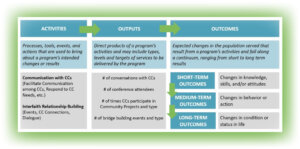
 What is it? A logic model is a one-page, compelling graphic (your road map) that tells the reader/reviewer exactly what, when, where, why, and how. It is one of, if not the most critical, element of your evaluation because it serves as the backbone to the entire program or project. Within it, resources, activities or strategies, along with their deliverables (outputs) are aligned with the project’s intended short, medium, and long-term outcomes. The goal of the process is complete alignment of all variables.
Evaluations are based on logic models in order to determine what exactly should be evaluated within the program or project. When you can clearly articulate the process, form, and function of your program, and it is aligned with the overall goal, then you are able to determine the most appropriate evaluation questions.
While logic models are imperatives for program proposals, there are increasing requests for them on research proposals (theories of change may be used in research when ideas are being explored). Logic models are often sent along with concept papers for a Program Officer’s review before the proposal is submitted. Collaborators and partners can quickly see what is needed of them within a program, as well as the intended results of their participation.
Very few people get the logic model right their first time — it takes some coaching and a few rounds of changes before the visual makes sense and appropriately tells your story. We can help you. In the meantime, check out our whitepaper entitled, How do we develop a Logic Model?
How can we help you?
- Develop succinct logic models
- Develop clear theories of change
- Confirm appropriateness of goals, objectives, outcomes (and outputs)

Baselines: The Bottom Line
Articles and White Papers About Impact Evaluation Baselines: The Bottom Line Read More What Are You Actually Measuring? Selecting the Right Indicator to Measure Progress Articles and White Papers About Monitoring & Evaluation To RCT or Not? Randomized Control Trials in Nonprofit Work Read More Whose Job is it to...
Read MoreTechnology Troubleshooting in M&E
Articles and White Papers About Monitoring & Evaluation To RCT or Not? Randomized Control Trials in Nonprofit Work Read More Whose Job is it to Evaluate? Read More The Problem with Relying Solely on Dashboards Read More Finalizing Reports: Statements of Differences Read More Load More
Read MoreM&E and Technology
Articles and White Papers About Monitoring & Evaluation To RCT or Not? Randomized Control Trials in Nonprofit Work Read More Whose Job is it to Evaluate? Read More The Problem with Relying Solely on Dashboards Read More Finalizing Reports: Statements of Differences Read More Load More
Read MoreTheories of Change
Articles and White Papers About Logic Models Baselines: The Bottom Line Read More Technology Troubleshooting in M&E Read More M&E and Technology Read More Theories of Change Read More Load More
Read More