Introduction
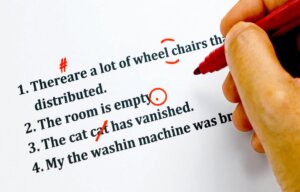
Copy editing goes beyond standard grammatical and syntactical corrections. It involves refining the tone, flow, and structure of a document to ensure that the information is clear and concise. Copy editing is crucial for several reasons. Namely, readers expect publications—whether online or in print— to be error-free and easy to read. When a source contains errors, it is often perceived as less credible, which can damage the reputation of the authoring organization and lead to financial loss. Failing to remove errors not only impacts your own work but also dilutes the broader body of literature. By adding substandard articles to the research pool, you risk making it harder for readers to identify high-quality content worth citing.
In addition, if publishing your work is a priority, having a copy editor can significantly improve the chances of acceptance. A skilled copy editor can help streamline revisions, reducing the back-and-forth process of making adjustments prior to publication. Copy editors don’t create content directly; instead, they work behind the scenes to enhance the work of authors, collaborating with other professionals involved in publishing. However, copy editing is not always straightforward. It requires a combination of reading comprehension, grammatical expertise, and language proficiency, making it challenging for both beginners and experienced editors. These skills are especially important in research or business settings where the writing topics may rely on collective knowledge. With that in mind, we have compiled a list of common pitfalls to watch out for when copy editing to facilitate best practices.
Methods & Examples
Traditional Editing
Even though the duties performed by copy editors go beyond normal proof reading, editing the text for grammar and syntax is still within the realm of their responsibility. When editing for grammar and syntax, look for misspelled words or missing punctuation. Pay attention to the small details here including any contractions or pronouns.[1] Some additional common errors are using “that” instead of “which”, and including similar versions of words that mean different things such as “except” versus “accept” or mirrored versions of words like “affect” verses “effect”. When editing for grammar and syntax, it is easy to overlook mistakes as they are often minor and may not appear to be wrong on first glance.
Tone and Flow
In addition to correcting grammar and syntax, one of the most common duties of copy editors is checking the text for flow and tone. The flow and tone of an article represent the authors’ thoughts and provide context for the information presented. Ensuring consistency and appropriateness in tone is important because it directly affects readability. Ultimately, the duties of copy editors are not only to minimize errors but also to enhance readability. Pay attention to the language used by the authors and assess the verbiage, terminology, and tone in which the information is delivered.
Pronoun & Nouns
In English, there are several ways to convey or assign meaning within sentence structure. One method involves the use of pronouns. Pronouns resemble nouns in appearance and sound, but they replace them in sentences to streamline language and avoid repetition.[2] This technique helps make sentences more manageable. However, pronouns can sometimes create confusion rather than clarity. Avoid using pronouns without first identifying the noun or clearly specifying what the pronoun refers to. One of the most commonly overused pronouns is “it.” While pronouns can simplify language, they can also introduce ambiguity. For instance, beginning a sentence with a pronoun like “it” can leave its reference unclear.[3] To fully leverage the advantages of pronouns, be cautious not to over use them.
Homophones
When editing, one of the more difficult challenges you may face is the use of homophones. Homophones are words that sound alike when spoken, yet have different spellings and convey different meanings. Common examples include “compliment” vs. “complement,” “effect” vs. “affect,” “than” vs. “then,” and “ensure” vs. “insure.”[4] It is important to carefully check which version of the word is being used. Printing a hard copy of your work can offer a fresh perspective when reviewing. Autocorrect is not reliable for catching homophones, as they often go unnoticed. While grammatical tools are improving, they still cannot replace the human element involved in copy editing.
Conclusion
Copy editing plays a critical role in enhancing the clarity, credibility, and readability of written works. Beyond correcting basic grammatical errors, a skilled copy editor refines the tone and flow of the document, ensuring that the content is presented coherently and professionally. This process not only improves the quality of individual publications but also contributes to the overall integrity of the relevant field, whether research, business, or media. By addressing common issues such as homophones, pronoun use, and sentence structure, editors can reduce ambiguity and streamline communication. Though tools like autocorrect have advanced, there is still no substitute for the nuances and attention to detail that human editors bring. While the pitfalls discussed in this article are not an exhaustive list of errors, they offer a solid foundation for those seeking to improve the skills needed for effective copy editing.
Take Away
Copy editing is a critical process that goes beyond basic grammar corrections, ensuring the clarity, flow, and professionalism of written works. This article explores common challenges faced by copy editors, such as pronoun misuse, homophone confusion, and maintaining a consistent tone. By understanding these issues, editors can enhance both the quality of individual publications and the credibility of the research field in question.
[1] Proof Communications Team. (2023, June 20). The most common mistakes we see when copy editing. Proof Communications. https://proofcommunications.com.au/editing/the-most-common-mistakes-we-see-when-copy-editing-business-documents/
[2] Robert Lee Brewer. (2022, December 13). What Is a Pronoun in Writing? (Grammar Rules). Writer’s Digest; Writer’s Digest. https://www.writersdigest.com/write-better-fiction/what-is-a-pronoun-in-writing-grammar-rules
[3] 6 Copyediting Mistakes to Avoid in Your Content. (2016). Smartbugmedia.com. https://www.smartbugmedia.com/blog/6-copyediting-mistakes-to-avoid-in-your-content
[4] Wick, A. (2022, December 9). Why You Should Beware Homophones. Writer’s Digest; Writer’s Digest. https://www.writersdigest.com/write-better-fiction/why-you-should-beware-homophones